
Parallel Bible Reading: How to Read Two Translations Side by Side
November 8, 2026
Every English Bible is a translation, and every translation makes choices. Reading two or three of them side by side lets you see those choices. Where the translations agree, you can be confident of the sense. Where they differ, you have found a place worth slowing down.
This guide explains why parallel reading helps, which translations make good pairs, what to do when they disagree, and how to set it up on paper or on a screen. No knowledge of Hebrew or Greek is needed.
Why read in parallel
- It shows the range of meaning. A single English word rarely covers everything the original word means. Two translations often catch two sides of it.
- It slows you down. Reading the same verse twice in different words makes you notice what it actually says, rather than what you remember it saying.
- It makes old words clear. A modern translation beside the King James Version explains words whose meaning has changed since 1611.
- It points to real questions. Some differences come from the manuscripts behind the translation or from a hard word in the original. Seeing the difference is the first step to understanding it.
An example
John 1:5 in four public-domain translations:
- KJV: And the light shineth in darkness; and the darkness comprehended it not.
- BSB: The Light shines in the darkness, and the darkness has not overcome it.
- WEB: The light shines in the darkness, and the darkness hasn’t overcome it.
- YLT: and the light in the darkness did shine, and the darkness did not perceive it.
“Comprehended” and “perceive” suggest the darkness did not understand the light. “Overcome” suggests it could not defeat it. The Greek word can carry both senses, grasping with the mind and seizing by force. Reading one translation, you get one meaning. Reading them together, you see that John may intend both: the world did not understand the light, and could not put it out.
Which translations to pair
Translations sit along a range. At one end are word-for-word translations, which keep the wording and sentence shape of the original as closely as English allows. At the other are thought-for-thought translations, which put the meaning into natural English even when that changes the wording. Most translations sit somewhere between.
The most useful pairs come from different points on that range:
- One familiar and one modern. The KJV beside the BSB or WEB. You keep the wording you know and see it in today’s English. Our guide to the KJV, BSB and WEB compares these three in detail.
- One literal and one readable. Young’s Literal Translation beside the BSB. YLT follows the original word by word, including verb tenses, which makes it awkward to read but good for seeing the structure.
- One older, one newer, from the same family. The ASV of 1901 beside the WEB, its modern revision, shows what a century of language change does to a text.
Two translations are enough for daily reading. Three is good for study. Beyond that, the columns become hard to read and the differences blur together.
What to do when they disagree
Most differences are only wording. A few change the meaning. When you notice one, ask these questions in order:
- Is it the same idea in different words? “Daily bread” and “appointed bread” are close. Note it and move on.
- Is an old word doing the work? The KJV’s “comprehended” meant both “understood” and “seized” in 1611. Check an older dictionary meaning before assuming the translations disagree.
- Is it a hard word in the original? If several modern translations differ from each other too, the original word probably has a range of meaning, as in John 1:5. A commentary or a study note will usually explain it.
- Is it a manuscript difference? Sometimes translations follow different ancient copies. Many Bibles mark these with a footnote. Romans 8:28 is a well-known example.
Write down the differences that change the meaning. A short note beside the verse (“KJV: comprehended, BSB: overcome, Greek can mean both”) is worth more than a page of notes you never reread.
Setting it up
On paper
Printed parallel Bibles put two or four translations in columns on each page. They are heavy and the type is small, but nothing is quicker to glance across. Two ordinary Bibles open side by side also work, especially for a single passage.
On a computer
A wide screen is the best place for parallel reading. Look for an app that keeps the columns aligned verse by verse as you scroll, so verse 5 in one column sits beside verse 5 in the others. Without that, the columns drift apart within a few verses, because translations differ in length.
On a phone
A phone is too narrow for comfortable columns. A better approach is to read in one translation and, when a verse catches your attention, open it in every translation at once. This is quicker than switching back and forth.
A simple routine
- Read the chapter through once in your main translation.
- Read it again with a second translation beside it, verse by verse.
- Mark any verse where the two differ in sense, not only in wording.
- Look at those verses in a third translation, and note what you find.
Ten or fifteen minutes is enough for most chapters. Over time you will learn the habits of each translation and spot the meaningful differences quickly.
Parallel reading in Carrell
Carrell includes seven public-domain translations: KJV, WEB, BSB, ASV, YLT, Darby and Webster. Every quotation on this page comes from the texts Carrell ships.
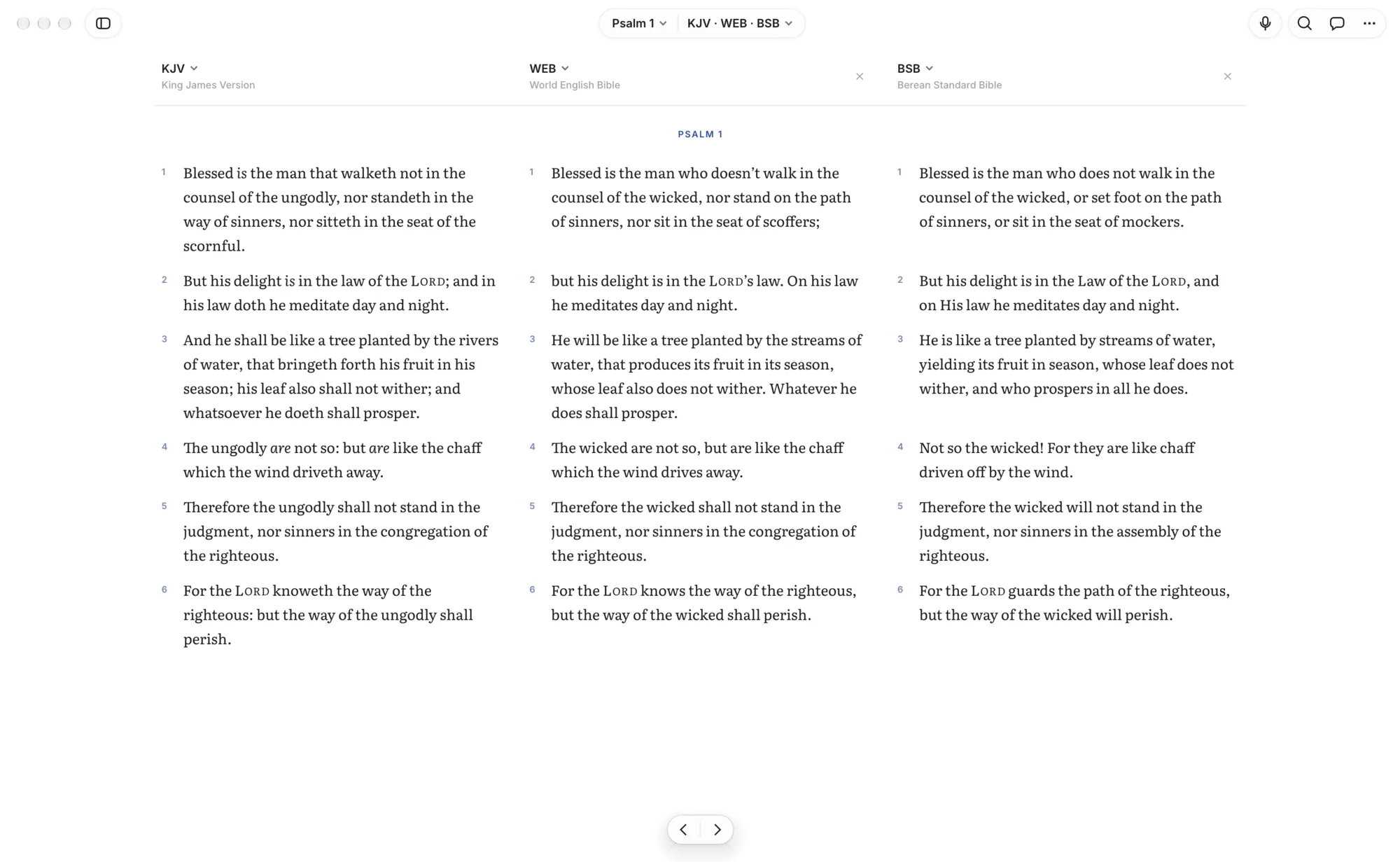
- On the Mac and Linux, parallel columns show translations side by side, aligned verse by verse.
- On every platform, including iPhone and iPad, Compare shows one verse in every translation you have.
- Notes sit beside the verse, so what you find stays with the passage it is about.
- You can import translations you own on the Mac and Linux, in USFM, OSIS, Zefania and SWORD formats. Licensed translations such as the NIV and ESV are not built in today.
Carrell is free for reading, the bundled Bibles, search, highlights and notes, on iPhone, iPad, Mac and Linux, and it is in beta. Download Carrell or see everything it does.